


Hearing Aids: Technology for Clear Hearing and a Full Life
Jul
Hearing loss is a reality that affects millions of people worldwide, significantly impacting communication, social relationships, and overall quality of life. Fortunately, modern hearing aids represent advanced and discreet technological solutions that can restore sound and connection. However, the variety of options available can be overwhelming. Understanding the differences between the main categories is essential to choosing the device that best suits individual needs, degree of hearing loss, and lifestyle.
Exploring the Main Categories
Behind-the-Ear hearing aids (BTE)
- Description: The main component (microphone, processor, amplifier, battery) is housed in a curved housing that fits behind the ear. A thin tube connects this housing to a custom-made earmold that is inserted into the ear canal.
- Differences: It's the most visible type (although miniaturized versions exist), but also the most powerful and versatile. It can accommodate larger batteries and multiple advanced features.
- Similarities: Like all hearing aids, they amplify and process sound digitally. They require professional fitting.
- Advantages: Maximum power (ideal for severe and profound hearing loss), greater durability, long-lasting batteries, less susceptible to wax buildup, and advanced connectivity options. Ideal for children (the ear mold can be easily replaced as they grow).
➤ Discover Our Selection of Behind-the-Ear Hearing Aids (BTE)
In-the-Ear Hearing Aids (ITE)
- Description: The entire device is contained in a unique, custom-made housing that sits completely within the outer ear (shell).
- Differences: More visible inside the ear than RIC or CIC hearing aids, but less so than traditional BTE hearing aids. They offer a good balance between size and power/functionality.
- Similarities: Custom-made for the user, they house all components in a single in-ear piece.
- Advantages: Easy to handle (larger size than CICs), can include more features (such as manual volume control or telecoil) and larger batteries than deep channel models, good power for moderate to severe losses.
➤ Discover Our Selection of In-the-Ear Hearing Aids (ITE)
Receiver-in-the-Canal Hearing Aids (RIC)
- Description: Similar to the BTE design, where there is a housing behind the ear, but crucially, the receiver (speaker) is separate from the main body and is placed inside the ear canal, connected to the housing by an ultra-thin, almost invisible wire.
- Differences: The in-canal earpiece allows for a more natural sound experience and reduces occlusion distortion (the "barrel-shaped" sensation). It's more discreet than traditional BTEs.
- Similarities: Retroauricular housing that houses the main components, including digital processing.
- Advantages: More natural, high-quality sound, greater comfort (less occlusion), discretion (very thin cable), replaceable earpiece if damaged. Versatile for mild to severe hearing loss. Very popular currently.
➤ Discover Our Selection of Ear-in-the-Canal Hearing Aids (RIC)
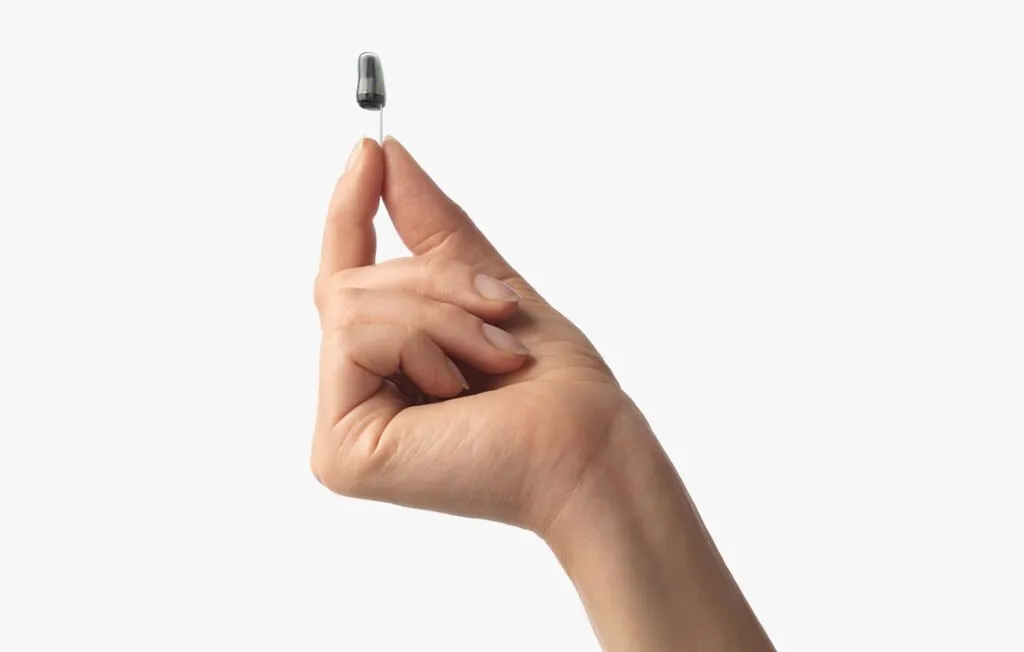
Invisible Hearing Aids (CIC – Completely In Canal / IIC – Invisible In Canal)
- Description: The smallest hearing aids available. They are custom-made to fit deep within the ear canal, making them virtually invisible from the outside. IICs are even deeper than CICs.
- Differences: Maximum discretion. Very small size.
- Similarities: Custom-made, all-in-one within the channel.
- Advantages: Unparalleled aesthetics (invisible), they take advantage of the natural anatomy of the ear for natural sound localization, less affected by wind.
- Disadvantages: Smaller batteries (shorter battery life), less room for additional features (such as powerful directional microphones or manual volume control), not suitable for severe or profound hearing loss or very narrow ear canals, which are more susceptible to earwax.
➤ Discover Our Selection of Invisible Hearing Aids (CIC)
Rechargeable Hearing Aids
- Description: It's not a physical style per se, but rather a power feature. They use built-in lithium-ion batteries that charge overnight in a base station, eliminating the need for disposable batteries. Available in BTE, RIC, and some ITE formats.
- Differences: They replace traditional batteries with rechargeable batteries.
- Similarities: They offer the same technology and features as their battery-powered counterparts.
- Advantages: Greater convenience (no need to change small batteries), more environmentally friendly (reduces battery waste), full overnight charging (guaranteed daily battery life for most users), ideal for people with manual dexterity issues. Some offer rapid charging.
➤ Discover Our Selection of Rechargeable Hearing Aids
Digital Hearing Aids
- Description: Current standard technology. All of the modern hearing aids mentioned above (BTE, ITE, RIC, CIC, rechargeable) are digital. They process sound using computer chips.
- Differences: They outperformed (obsolete) analog hearing aids in processing power, customization, and noise reduction.
- Similarities: They all amplify sound in a non-linear way, focusing on the frequencies of speech.
- Advantages: Advanced sound processing (noise reduction, directional focusing, feedback suppression – whistling), precise programming by the audiologist based on the user's audiometry, wireless connectivity with smartphones and TVs, and handling of complex listening environments.
➤ Discover Our Selection of Digital Hearing Aids
OTC Hearing Aids (Over-The-Counter)
- Description: A new regulated category (primarily in the US, but with global influence) aimed at adults with mild to moderate hearing loss. They are sold directly to consumers without a prescription or mandatory professional fitting, although they often offer remote support. They are typically preconfigured BTE or RIC models or can be self-adjusted via an app.
- Differences: Easier and more affordable access, self-fitting or simplified adjustments, and less customization than professionally fitted models.
- Similarities: Basic digital technology amplifies the sound.
- Advantages: Lower initial cost, greater accessibility (no need for initial specialist visits), and convenience.
- Critical Considerations: They are not suitable for severe or complex losses. Self-fitting can be insufficient or even harmful if not performed correctly. A prior hearing evaluation (although not mandatory) is crucial to confirm that the hearing loss is mild to moderate and has no treatable medical causes.
➤ Discover Our Selection of Certified OTC Hearing Aids
Comparison Table: Key Benefits by Category
| Category | Main Advantages |
|---|---|
| BTE (Behind the Ear) | Advanced processing (noise reduction, directionality), precise customization, Bluetooth connectivity, and performance in complex environments (Applicable to BTE, ITE, RIC, and CIC hearing aids). |
| ITE (Intra-auricular) | Good balance of size and power (mild-moderate-severe). Easy to use, can include more manual functions than CIC. |
| RIC (In-Canal Receiver) | Natural and high-quality sound, great comfort (minimizes occlusion), discreet (thin cable), replaceable earpiece, versatile (Mild-severe). |
| CIC/IIC (Invisibles) | Maximum discretion (practically invisible), takes advantage of the natural anatomy of the ear, less affected by wind. |
| Rechargeable | Convenient (no battery changes required), eco-friendly, all-day battery life with overnight charging, ideal for dexterity issues. Ideal for everyone. |
| Digital | Maximum discretion (virtually invisible), takes advantage of the natural anatomy of the ear, less affected by wind. |
| OTC (Over the Counter) | Lower initial cost, greater accessibility without a prescription, convenience for mild-moderate losses. |
Conclusion: Personalized Choice is Essential
There is no universal "best hearing aid." The optimal decision arises from a thorough evaluation by an audiologist or hearing specialist, considering:
- The degree and type of hearing loss: It is the main determining factor.
- The anatomy of the ear: Size and shape of the ear canal.
- Lifestyle and needs: Work activity, social, use of technology, importance of discretion.
- Manual dexterity: For handling small devices or changing batteries.
- The budget: Considering not only the initial cost, but also maintenance and batteries/recharging.
Technological advances continue to improve the sound quality, noise reduction, connectivity, and discretion of hearing aids. Whether opting for the power of a BTE, the naturalness of a RIC, the invisibility of a CIC, the convenience of rechargeables, or the initial accessibility of OTCs (with proper precautions), the ultimate goal is the same: to reconnect people with the sound world around them, significantly improving their communication, safety, and overall well-being. Always consulting with a hearing care professional is the essential first step toward a successful and satisfying hearing solution.