


Rechargeable Hearing Aids vs. Battery-Powered Hearing Aids: Advantages and Disadvantages
Sep
One of the most common dilemmas when choosing a modern OTC hearing aid is the type of power: rechargeable hearing aids vs hearing aids with batteries. It's an important decision that will affect your daily life, your comfort, and your wallet in the long run.
At AudioTok, we want you to make the best decision for your needs. That's why we've created this detailed comparison, analyzing the pros and cons, and giving you our honest recommendation.
Evolution: Rechargeable Batteries Are Here to Stay
A few years ago, battery-powered devices were the standard. Today, rechargeable lithium-ion battery technology (the same as in smartphones) has transformed the market. But this doesn't mean one option is always better than the other. It's up to you.
Rechargeable Hearing Aids: Modern Convenience
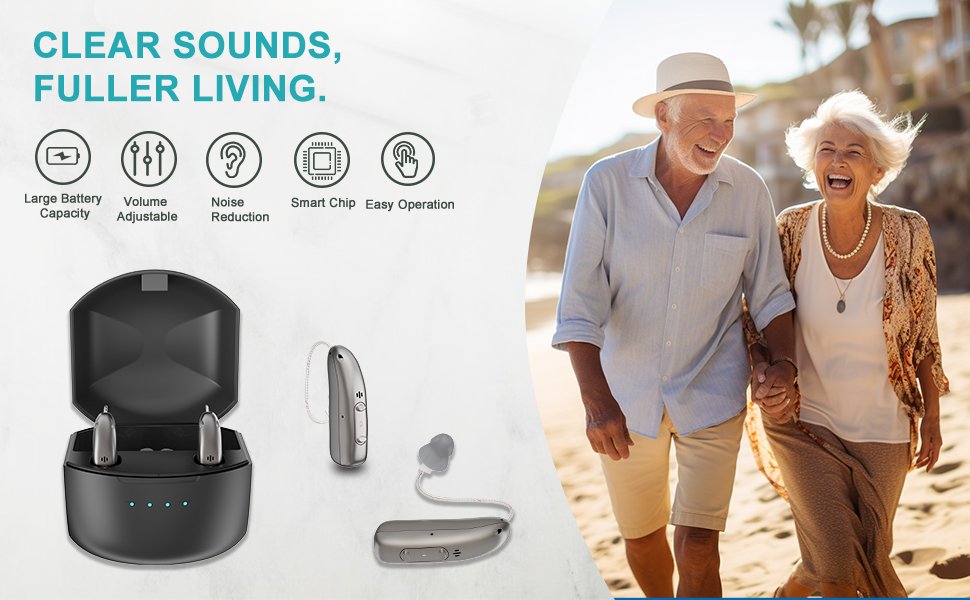
Operation: They come with a charging station. At the end of the day, simply place the earbuds in the case, and they'll be 100% charged by morning.
✅ Advantages:
- Maximum comfort and simplicity: Forget about handling tiny batteries. Charging becomes as natural as charging your phone. Ideal for people with limited manual dexterity.
- Fast charging: Many models offer a 30-minute fast charge para varias horas de uso, perfecta para un imprevisto.
- Less waste and more ecological: By not using disposable batteries, you significantly reduce your environmental impact and the generation of toxic waste.
- Charging case as storage case: The same case protects and charges the headphones, all in one. They tend to be more compact and elegant designs.
- Consistent performance: They provide stable voltage throughout the day, unlike batteries that gradually lose power.
❌ Disadvantages:
- Dependence on a plug: If you forget to charge them or don't have access to electricity (e.g., on a multi-day camping trip), you could be left without a hearing aid.
- Battery life: Like any battery, its charging capacity decreases over time (usually after 3-4 years), at which point you may need a professional replacement.
- Slightly higher initial cost: Rechargeable models typically have a higher purchase price than their battery-powered counterparts.
Battery-Powered Hearing Aids: Traditional Reliability
Operation: They use disposable button cell batteries (usually size 10, 312 or 13) that must be replaced every few days or weeks.
✅ Advantages:
- Maximum autonomy and "security": If you run out of batteries, you can carry spare batteries with you and replace them in seconds anywhere. You won't be dependent on a power outlet.
- Lowest initial cost: The purchase price of the hearing aid is usually cheaper.
- Ideal for occasional use: If you don't use your hearing aids every day, the batteries can last for weeks or months, making them a very practical option.
- No battery degradation: There's no need to worry about the lifespan of an internal battery. Performance is constant until the battery is depleted.
❌ Disadvantages:
- Continuous and accumulated cost: Constantly purchasing batteries becomes a recurring expense that, in the long run, can outweigh the price difference with the rechargeable model.
- Awkward handling: The batteries are tiny and may be difficult to handle for people with arthritis or tremors.
- Logistics and availability: You have to remember to buy batteries and make sure they don't run out at the most inopportune moment. They're not always easy to find in smaller stores.
- Waste: You generate a constant stream of waste that must be disposed of properly (it is toxic to the environment).
Quick Comparison Table
| Feature | Rechargeable Hearing Aids | Hearing Aids with Batteries |
|---|---|---|
| Comfort | High (Easy loading) | Low (Battery change) |
| Long-Term Cost | More economical (No recurring purchases) | More expensive (Battery expenditure) |
| Autonomy | Depends on load (1 full day) | High (Spare batteries) |
| Sustainability | Excellent (Zero waste) | Low (Constant residues) |
| Ideal for | Daily use, active lifestyle, maximum comfort. | Occasional use, long trips without electricity. |
Our Final Recommendation on AudioTok
For most users, we recommend rechargeable hearing aids. The convenience of not having to deal with batteries, combined with the long-term cost savings and environmental benefits, makes this the most advantageous option for everyday use. The technology has matured to the point where it offers reliable and excellent performance throughout the day.
When would we recommend a battery-powered model?
- If you are a occasional user of hearing aids.
- If you travel frequently to remote areas without easy access to electricity for several days.
- If you initial budget It is very tight and you prioritize the initial outlay over recurring expenses.
An Example in Our Store: The Choice is Yours
At AudioTok, we offer both options for you to choose from depending on your lifestyle. For example, our model ZF-M908 It is available in both a rechargeable and battery-powered version, so you can choose the one that best suits your routines.
Conclusion: Think about your daily life
The final decision comes down to your lifestyle and personal preferences.
- Do you value absolute comfort and modernity? -> Elige Rechargeable.
- Do you need unlimited autonomy and prioritize the initial cost? -> Elige Batteries.
Do you have doubts about which model best suits your routine? Our team at AudioTok is here to advise you without obligation. Contact us and we'll help you find the perfect solution for your ears.